💡 Today's Content Summary
- An introduction to Cyberdigm's company-wide effort to proactively lead change, keeping pace with the AI wave that has become the defining topic of global business.
- In-depth insights ranging from "how to collaborate with AI" for non-developer practitioners to "how to build AI systems" for developers.
- Backed by the sweeping support—including official Claude accounts for every employee—a look at the hands-on innovation arena where staff solve everyday inconveniences themselves and maximize productivity.
Hello, this is Cyberdigm. 😊
Without question, the most talked-about topic in global business today is "AX (AI Experience · AI Transformation)."
It is no longer enough simply to understand the technology behind AI; the question that now determines a company's
survival is how to weave it into actual work processes and maximize productivity.
As a leader in Korea's document centralization market, Cyberdigm is concentrating
its company-wide capabilities to ride this AI wave as swiftly and proactively as possible.
As a concrete part of that effort, we are currently holding a [Company-Wide AX Competition],
and we recently hosted an [AI Education Seminar] to help employees make the most of AI.
Here's an on-site sketch of that energetic event!
Employee AI Seminar: How to Use AI as a "Colleague," Not a "Search Bar"
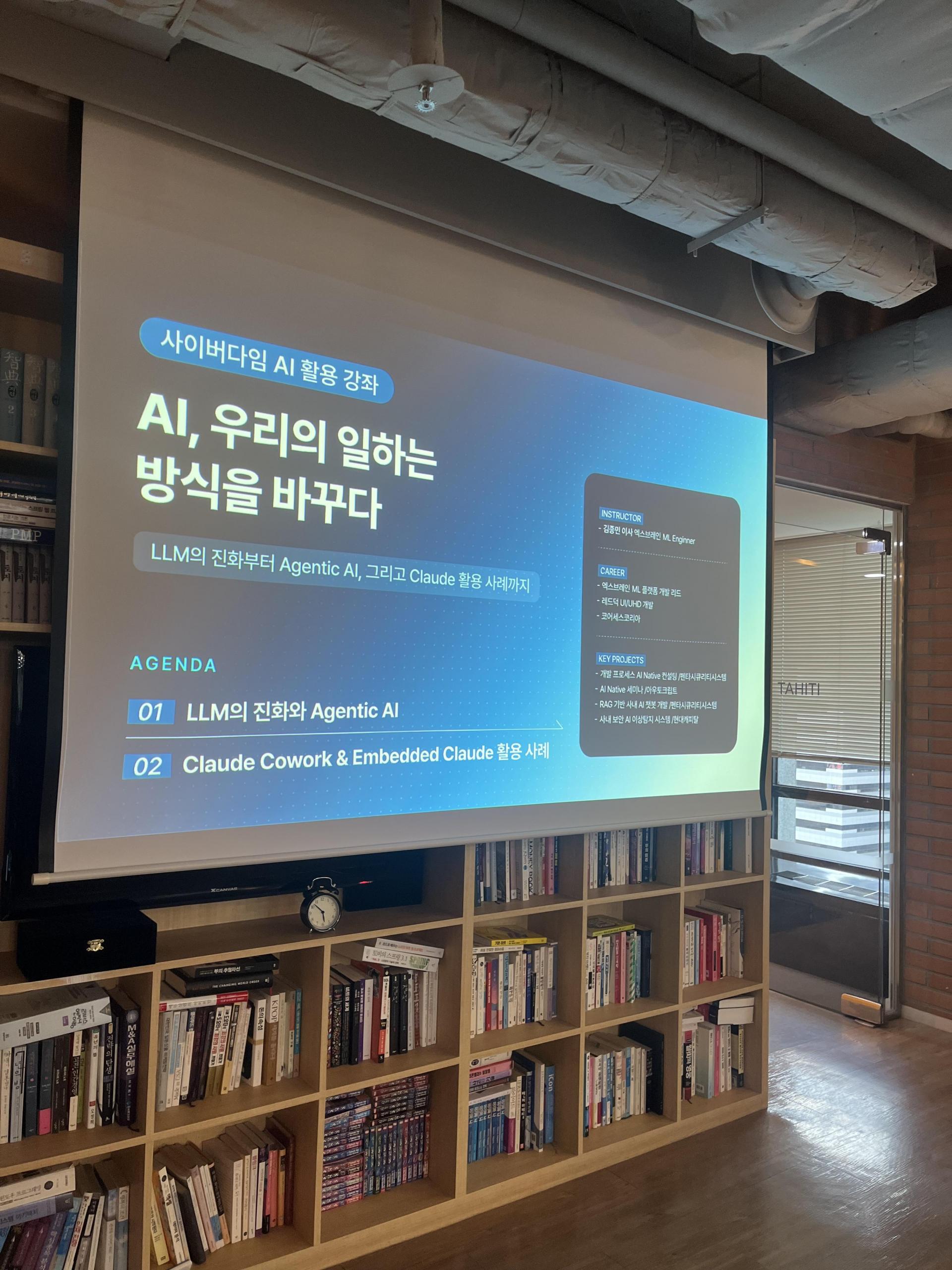
This seminar was held to share in-depth insights on how to integrate and apply AI in our work.
Mindful of the different roles across our organization, we designed two tailored sessions:
Session 1 (for non-developers and practitioners) and Session 2 (for developers).
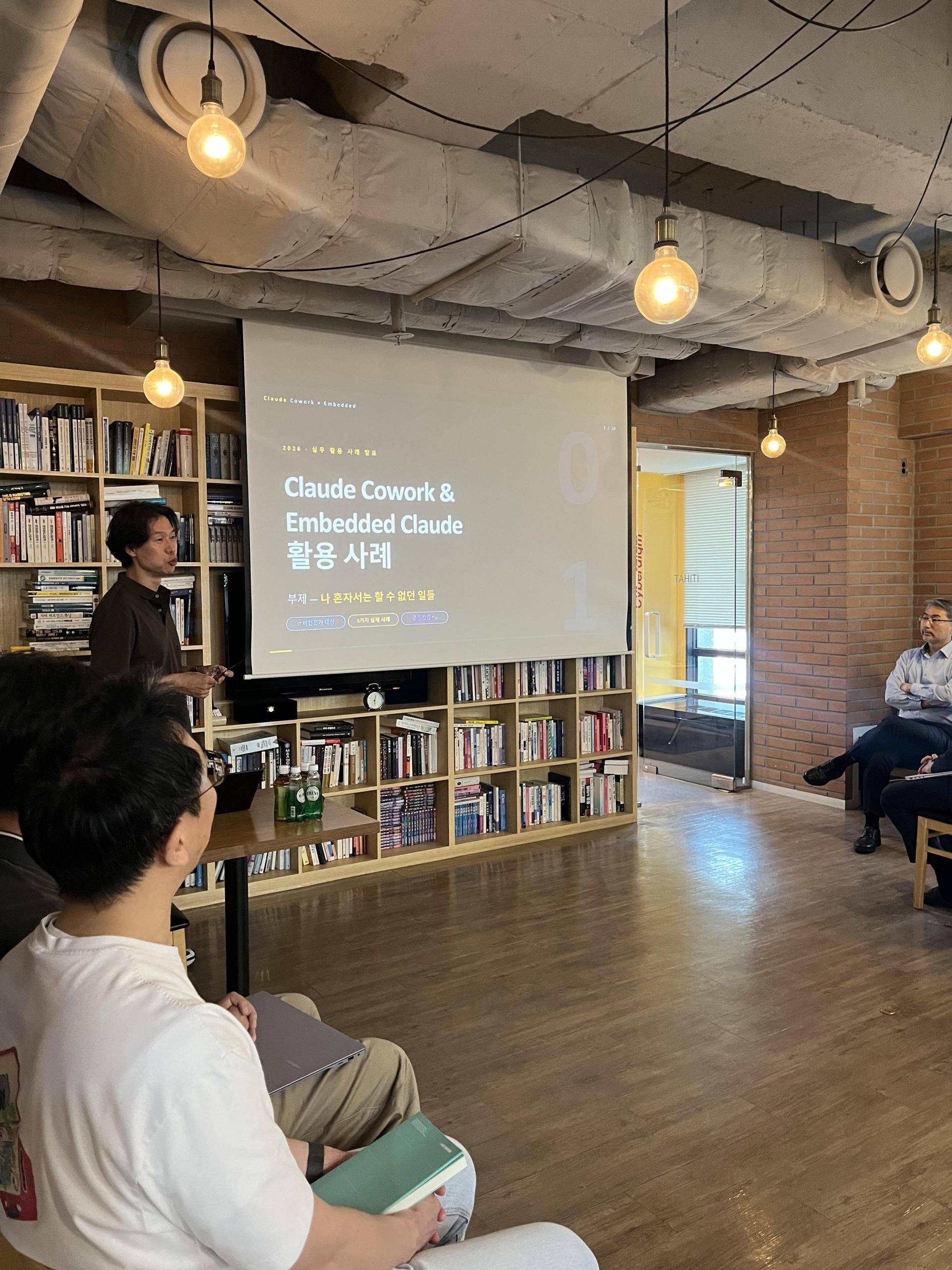
Planit Square CEO Jeong Seong-il
Session 1 Recap — "AI isn't a search bar for tossing out questions; it's a colleague working together."
The first seminar focused on how non-developer practitioners can collaborate
with AI to move beyond the limits of their work.
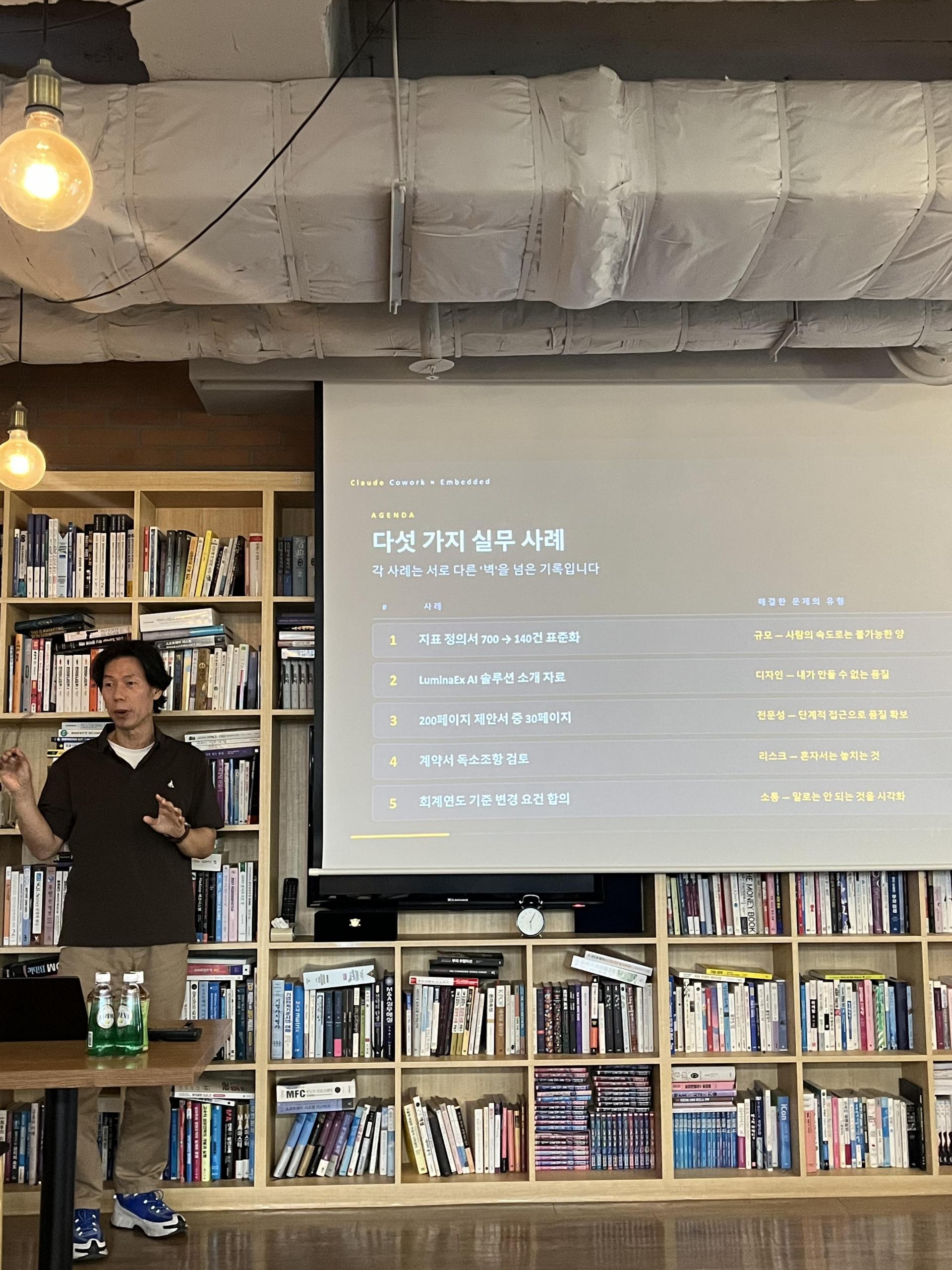
1. The Work You Couldn't Do Alone — Overcoming Barriers with AI
We shared five real cases of accomplishing, together with AI, the work that could not be finished alone,
on time, and at the desired quality. These ranges from automatically classifying more than 700 legacy documents with
inconsistent formats, to overcoming the limits of PowerPoint design, condensing lengthy proposals,
filtering out toxic clauses in contracts, and visualizing complex rules on screen to reduce miscommunication.
Because each example could be applied to real work right away, the session drew an enthusiastic response.
2. The Basics of AI — So What Exactly Is AI?
Tools like ChatGPT and Claude are generative AI—specifically, LLMs that handle text.
The underlying principle is surprisingly simple: they continuously predict
"the word most likely to come next," and this accumulates into conversation, coding, and even analysis.
When added to the concept of an agent, the AI begins to determine for itself which tools it needs and how to use them.
The key insight is this: we've moved from an era of building AI ourselves to an era of making good use of well-built AI.
3. A Practical Application Guide — How Do I Bring It Into My Work?
The key lies in providing AI with context in advance. When you put the know-how, reference materials,
and work rules in your head into writing and gather them in one place (e.g., Notion),
the AI will draw on them automatically, without an explanation each time. As a result, the way we work changes as well.
Once a task is delegated to AI, more can be accomplished within the same amount of time.
💡 Session 1 distilled a wealth of ready-to-use know-how into single sitting,
equipping non-developer practitioners to treat AI as a "real colleague" and move beyond the limits of their work.
Session 2 Recap — How to Work With AI, and How to Build It
The second session, intended for developers, went a step deeper:
"from working alongside AI to building AI products for in-house use."
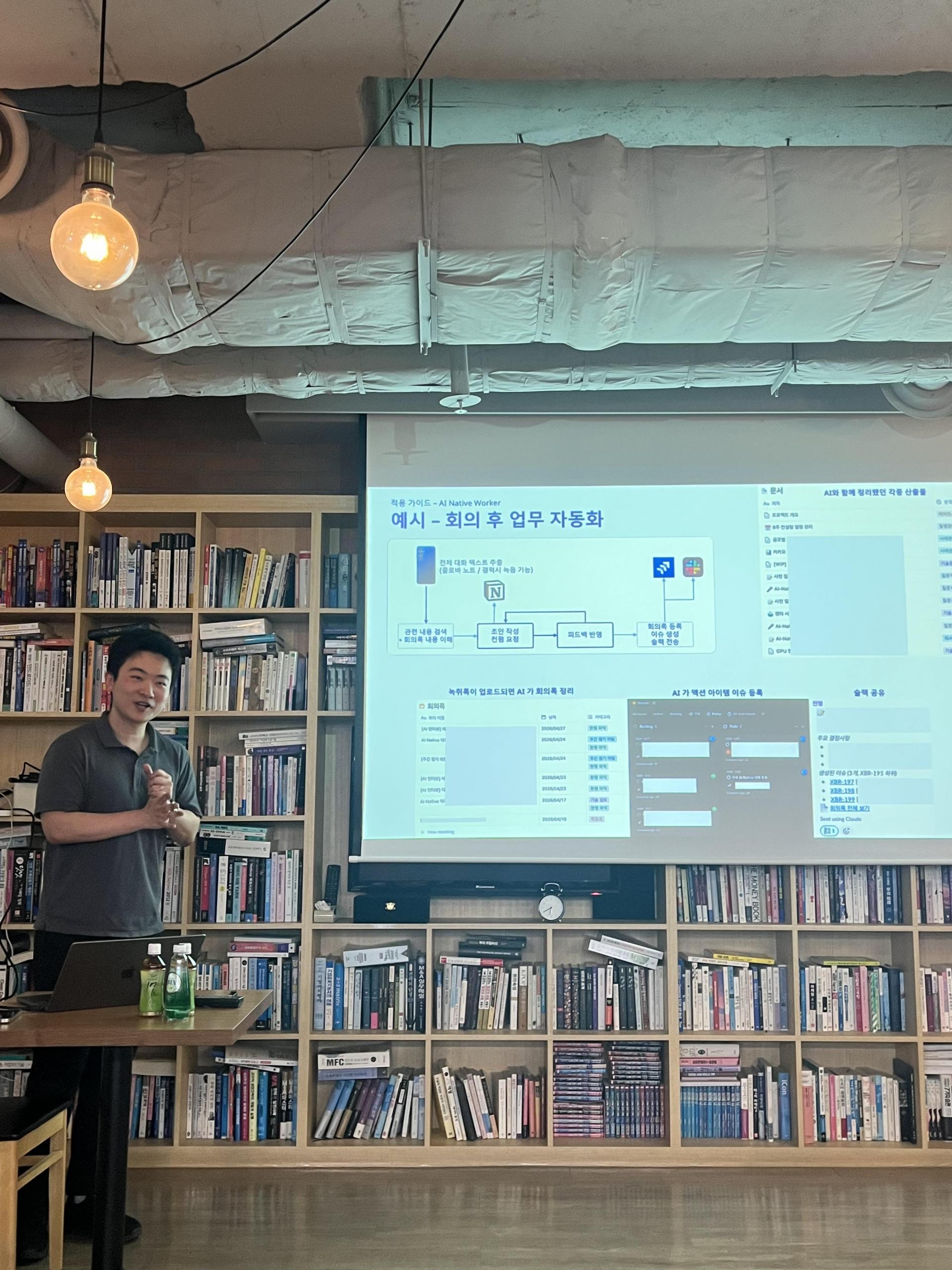
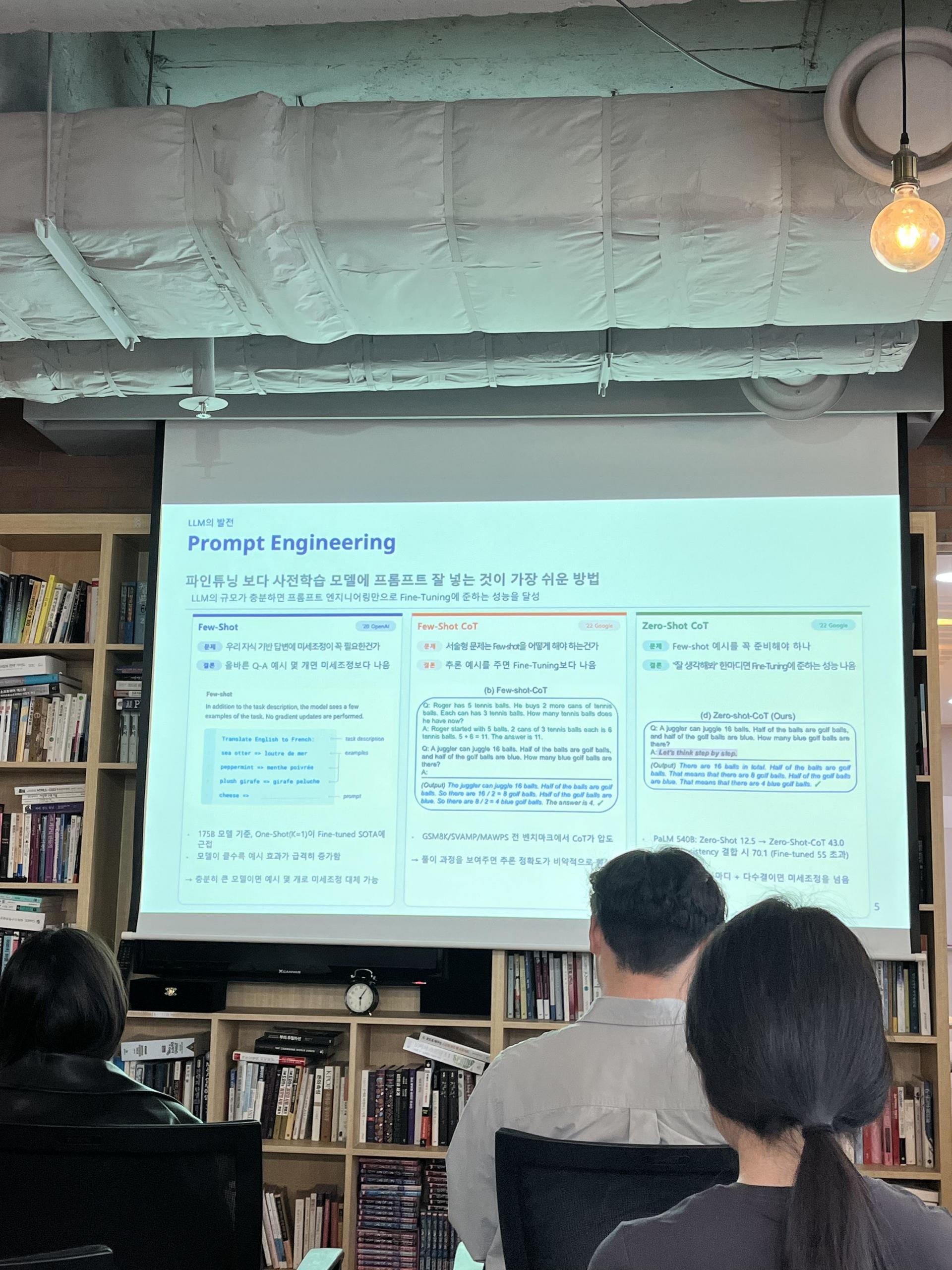
Director Kim Jong-min, XBrain Inc. · ML Engineer
1. Understanding AI — How Does AI Become Smarter?
"Rather than re-training AI, asking a well-crafted question (prompt) is far easier and more effective!"
Just as people grasp a concept after seeing a few examples, AI's performance improves dramatically when given good
examples or even simple instruction to "think step by step." The session highlighted the essentials of RAG
(which searches internal materials to ground its answers in source), AI agents (which select their own tools),
and context engineering (which supplies the right context).
2. AI Native Development — Transformiong How We Work
The era of typing out every line of code by hand has passed. The roles now shift toward a structure in which
"humans define what to build ➡️ AI drafts it ➡️ humans review and decide." Sharing a case where the SDD
(Specification-Driven Development) approach—writing the specification first and
entrusting implementation to AI—dramatically reduced the development time,
the session concluded that repetitive work should be left to AI while people can concentrate on "design and judgment."
3. Building AI Systems — Creating a Safe, Controlled AI Environment
Finally, the session addressed how to adopt AI safely at the company level. It emphasized the importance of building
safe infrastructure—operating in-house models so that sensitive internal data is never exposed externally,
and retaining flexibility to switch between different AI models depending on the situation.
💡 Session 2 offered developers a comprehensive view, covering "how to work with AI and build AI products firsthand"—from
prompting techniques to specification-based AI development (SDD),
and the construction of systems that keep internal data secure.
Cyberdigm [AI Work Automation Competition]: An Arena for Real-World Innovation
If the seminars filled us with knowledge, the time has now come to put it into practice!
To firmly establish AX across the company, Cyberdigm has launched the [1st CAI (Cyberdigm AI) Competition],
where every employee experiences AI firsthand and improves efficiency within their own departments.
🔥Cyberdigm's Sweeping Support!
To lead the way in activating company-wide AX, we are officially providing every employee with a Claude Team account,
offering an environment where they can innovate freely.
Amid this sweeping support, the participants are taking the small inconveniences they encounter in their daily work as
inspiration, and competing on the concrete deliverables that maximize productivity with AI. We look forward,
with great anticipation, to the remarkable automation know-how that will emerge!
Leading the AI Wave, Opening the Future of Solutions
Cyberdigm is sparing no company-wide investment in technology, determined to stay ahead of vast,
fast-changing AI wave rather than fall behind it and to lead the trend.
Beyond improving the efficiency of individual employees' work processes, our ultimate destination is to integrate
advanced AI technologies—such as an AI Assistant*—into the "document centralization solution" we build.
* Learn more about AI Assistant →
A company unafraid of change, one that learns technology first and proves it through products and value—
we invite you to the safe, intelligent future of AX that Cyberdigm will open.



💡 Today's Content Summary
Hello, this is Cyberdigm. 😊
Without question, the most talked-about topic in global business today is "AX (AI Experience · AI Transformation)."
It is no longer enough simply to understand the technology behind AI; the question that now determines a company's
survival is how to weave it into actual work processes and maximize productivity.
As a leader in Korea's document centralization market, Cyberdigm is concentrating
its company-wide capabilities to ride this AI wave as swiftly and proactively as possible.
As a concrete part of that effort, we are currently holding a [Company-Wide AX Competition],
and we recently hosted an [AI Education Seminar] to help employees make the most of AI.
Here's an on-site sketch of that energetic event!
Employee AI Seminar: How to Use AI as a "Colleague," Not a "Search Bar"
This seminar was held to share in-depth insights on how to integrate and apply AI in our work.
Mindful of the different roles across our organization, we designed two tailored sessions:
Session 1 (for non-developers and practitioners) and Session 2 (for developers).
Planit Square CEO Jeong Seong-il
Session 1 Recap — "AI isn't a search bar for tossing out questions; it's a colleague working together."
The first seminar focused on how non-developer practitioners can collaborate
with AI to move beyond the limits of their work.
1. The Work You Couldn't Do Alone — Overcoming Barriers with AI
We shared five real cases of accomplishing, together with AI, the work that could not be finished alone,
on time, and at the desired quality. These ranges from automatically classifying more than 700 legacy documents with
inconsistent formats, to overcoming the limits of PowerPoint design, condensing lengthy proposals,
filtering out toxic clauses in contracts, and visualizing complex rules on screen to reduce miscommunication.
Because each example could be applied to real work right away, the session drew an enthusiastic response.
2. The Basics of AI — So What Exactly Is AI?
Tools like ChatGPT and Claude are generative AI—specifically, LLMs that handle text.
The underlying principle is surprisingly simple: they continuously predict
"the word most likely to come next," and this accumulates into conversation, coding, and even analysis.
When added to the concept of an agent, the AI begins to determine for itself which tools it needs and how to use them.
The key insight is this: we've moved from an era of building AI ourselves to an era of making good use of well-built AI.
3. A Practical Application Guide — How Do I Bring It Into My Work?
The key lies in providing AI with context in advance. When you put the know-how, reference materials,
and work rules in your head into writing and gather them in one place (e.g., Notion),
the AI will draw on them automatically, without an explanation each time. As a result, the way we work changes as well.
Once a task is delegated to AI, more can be accomplished within the same amount of time.
💡 Session 1 distilled a wealth of ready-to-use know-how into single sitting,
equipping non-developer practitioners to treat AI as a "real colleague" and move beyond the limits of their work.
Session 2 Recap — How to Work With AI, and How to Build It
The second session, intended for developers, went a step deeper:
"from working alongside AI to building AI products for in-house use."
Director Kim Jong-min, XBrain Inc. · ML Engineer
1. Understanding AI — How Does AI Become Smarter?
"Rather than re-training AI, asking a well-crafted question (prompt) is far easier and more effective!"
Just as people grasp a concept after seeing a few examples, AI's performance improves dramatically when given good
examples or even simple instruction to "think step by step." The session highlighted the essentials of RAG
(which searches internal materials to ground its answers in source), AI agents (which select their own tools),
and context engineering (which supplies the right context).
2. AI Native Development — Transformiong How We Work
The era of typing out every line of code by hand has passed. The roles now shift toward a structure in which
"humans define what to build ➡️ AI drafts it ➡️ humans review and decide." Sharing a case where the SDD
(Specification-Driven Development) approach—writing the specification first and
entrusting implementation to AI—dramatically reduced the development time,
the session concluded that repetitive work should be left to AI while people can concentrate on "design and judgment."
3. Building AI Systems — Creating a Safe, Controlled AI Environment
Finally, the session addressed how to adopt AI safely at the company level. It emphasized the importance of building
safe infrastructure—operating in-house models so that sensitive internal data is never exposed externally,
and retaining flexibility to switch between different AI models depending on the situation.
💡 Session 2 offered developers a comprehensive view, covering "how to work with AI and build AI products firsthand"—from
prompting techniques to specification-based AI development (SDD),
and the construction of systems that keep internal data secure.
Cyberdigm [AI Work Automation Competition]: An Arena for Real-World Innovation
If the seminars filled us with knowledge, the time has now come to put it into practice!
To firmly establish AX across the company, Cyberdigm has launched the [1st CAI (Cyberdigm AI) Competition],
where every employee experiences AI firsthand and improves efficiency within their own departments.
🔥Cyberdigm's Sweeping Support!
To lead the way in activating company-wide AX, we are officially providing every employee with a Claude Team account,
offering an environment where they can innovate freely.
Amid this sweeping support, the participants are taking the small inconveniences they encounter in their daily work as
inspiration, and competing on the concrete deliverables that maximize productivity with AI. We look forward,
with great anticipation, to the remarkable automation know-how that will emerge!
Leading the AI Wave, Opening the Future of Solutions
Cyberdigm is sparing no company-wide investment in technology, determined to stay ahead of vast,
fast-changing AI wave rather than fall behind it and to lead the trend.
Beyond improving the efficiency of individual employees' work processes, our ultimate destination is to integrate
advanced AI technologies—such as an AI Assistant*—into the "document centralization solution" we build.
* Learn more about AI Assistant →
A company unafraid of change, one that learns technology first and proves it through products and value—
we invite you to the safe, intelligent future of AX that Cyberdigm will open.